Wednesday, August 17, 2016

Preparing to Live Off Grid


Water

The first issue we face with being off grid  is our water source.  The farm has an old bored well with a pump that is a few years old.  We haven't yet tested the pump or the water, but that will be happening during the next trip.  

There is no way to know how old this bored well is, but the pump and tank are most likely around 2-3 years.

Well pump and tank
With an well that has been unused for a long time there are measures that must be taken to ensure the water is safe to drink. 

It's odd that the health department is very strict about the septic system, but absolutely could care less about the source and condition of the drinking water.

The plan is to begin by getting a close measurement of how much water is in the well and determine how much bleach to use to shock it.  Following that treatment, we then run the water through the system, i.e. pump and storage tank, and take a primary sample. 

We will be replacing the tank with new, larger one.  And once we know whether we can salvage the pump, we will proceed from that point.

Next, according the instructions from VA Tech and the state, the water must run through the system to for a while to flush the system and then we take another sample for testing.  Both samples are used for comparison.

States may have their own set of instructions for testing wells and you should research for your area. Usually the state university will have an agricultural extension which provides all the information you will need to help get settled on your off grid land.


Electric Power

At some time we will be getting connected to the power lines, but until that time we must produce our own electricity.   This $300,  gas powered generator produces 3300 watts of power and is sufficient to run the refrigerator, lights, microwave and even the flat iron.  It also runs the air conditioning, and supplements the motor-home's battery system.

Depending on the load, we must refill the 2.5 gallon tank at least twice a day.  We keep it running all the time for the refrigerator and to keep the battery system charged.  

The electric power in this area is very affordable so we will be connecting once we have our permit from the health department.  However, it never hurts to have an alternative to the grid, and we are researching solar and wind options.  For the well especially, if the grid goes down how will we get our water?  The bored well is shallow enough to drop a bucket, but a hand pump or wind mill would definitely be better.   

There are a myriad of web sites about alternatives, so investigate as many options as you can until you find what will work best for you and your situation.

At this time, for our current situation, the generator is our best option, although it is temporary.

No Septic System

That's right, no septic system.  Since we will be using water-less toilets we don't need a septic system.
This doesn't mean can just use any alternative however.  The health department must approve our method for disposing of "human waste" as well as how we will deal with the gray water created by showers, sinks and washing machines.  

Once again, each state has its own regulations regarding these systems so check with your state's Department of Health before doing anything.  

For us, at this time, the water-less toilet model we have selected has been approved by the VHD, but now we must meet with someone in the conservation department regarding the gray water.  Not all water filters are approved in all states.  But, after discussing the topic with the VHD agent we know that once the gray water has been filtered we can just let it flow on the grass, or trees, as long as it isn't used to water livestock or food gardens.  

Water-less toilets come in many types from a 5 gallon bucket fitted with a seat and using saw dust, to an electric design that incinerates the solid waste so it is burned into ashes.    Once again, do a web-search for water-less toilets and investigate until you find what will work best for you.

Once you have decided on the toilet, the next step is dealing with the gray water.  Gray water is water from showers, sinks, washing machines, etc. Daily household waste water is gray water.  Because this water may contain organic matter, such as can be found in water from the kitchen sink, it must be filtered before being released into the environment.  

Some states are have more stringent regulations than other states, so once again check with your states Health Department.

There are many of benefits to using this method of processing both black and gray water.  First and foremost is the money saved by not needing a costly septic system installed.  This system also benefits the land as neither system will contaminate the ground water or the soil.


Tuesday, August 16, 2016

We Found the End of the Rainbow

Yes, I know it's a silly saying, but in this case it is the literal truth.  This rainbow ended in our east pasture, near the tree line.  I wish the colors were stronger and easier to see, but in reality, it was so brightly lit that we could walk straight to the area where it came down.
Follow the curve of the rainbow to see where it met the ground between the treeline and the field shelter.

This rainbow appeared following a late afternoon "sun" shower.  You know the kind, when the sun is shining brightly and the sky is blue, then suddenly there is a downpour.  As kids it was the only time my mother would let us play outside while it was raining.

The following morning was foggy.  Very foggy.  The treeline was just a darker shade of gray, but it was amazing what became visible due to the fog:


These webs were everywhere attached to blades of grass in the more than 10 acre pasture. This is the same pasture as the rainbow photo and looking in the same area.  The grass is more than waist high.

This huge web appeared outside the bedroom window of our motor-home.  I looked through that window each morning upon awakening and never saw it until this foggy morning.  It became less and less visible as the sunlight grew and the fog faded.

I wondered out loud to Nick, "Does the rainbow ending here, in the middle of the farm, mean that this is our pot of gold?"

Nick didn't reply, but he did slightly tilt his head and give me one of those strange looks that is accompanied by a small grin and twinkle in his eye.  

Monday, August 15, 2016

On the Road Again.... Oh no I'm channeling Willie Nelson!

It seems like we are always on the road again, traveling back and forth the 600 miles to the farm in VA and back again to the little Henny Penny homestead in CT.  This time we stayed down on the farm for two weeks, leaving the Henny Penny in the capable hands of our grandson.  It's amazing how much the garden had grown in those two weeks.  Before we left I had doubts that we would get anything to harvest, but I was wrong and the plants have been producing.

But that is for another post, this post is about our recent trek down south.  We continue to be at a stand-still for our building permit.  Just one more hoop after another.  Now that the Virginia Health Dept has said okay for the use of waterless toilets, it had to issue a "letter of denial" for the septic system, and indeed, for the entire property.  Without even testing, we were told it fails because the existing system fails. Period.  Now, we have to get a conservation designer, I think that's the title, to approve a filter system for gray water, even though we haven't been able to find any regulations regarding residential gray water management.  Once he approves how we will deal with the gray water, he will send his report to VHD and hopefully we will finally be issued our building permit.... to restore the interior of the home.

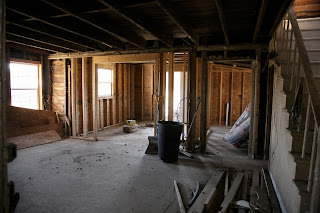
You have been so patient and supportive in our journey I thought I would give you a glimpse of the home interior.

This view is from the front door looking toward the back door.  The stairs lead to two bedrooms upstairs.  This front room has a fireplace, to the far left.  Straight ahead to the right is the bathroom and the large opening to the left leads to the kitchen which measures only 12'x12'.  The back door, which is open, leads to the "back porch" which is equal in area to the kitchen and bath areas.
 This is the view from the fireplace.  The front door is to the right.  The doorway beneath the stairway leads to another room.  For perspective, the living room is 14' wide and about 20' to the back wall at the stairway.  The ceiling height is 8'.   Nick is 6'4".
 This is the bathroom.  The laundry ares is currently set at that rear wall, and tub/shower enclosure is to the immediate right.  The vanity would be placed at the left.  Most of this is being changed.  Note the metal roof.
 Welcome to the kitchen.... all 12' x 12' of it.  This is going to take some creativity.
 Back to the living room, facing the front door from the bathroom doorway.  That bright area is the enclosed front porch, which I cannot wait to open up and restore it to a front porch proper.
 This is the room behind the stairway.  Two large windows and old cement block chimney will be changed. This room and the two rooms upstairs are all 14' x 14' and each has two large windows, each directly across from each other.  Perfect for ventilation during the warmer months.  There is always such a nice breeze blowing through the rooms.
 This is directly above the room behind the stairway; the downstairs room looks just like this.
Don't you love an old, narrow stairway?  Neither do we, although it is narrow, the steps are sturdy and easily managed.

So, now you have had your peek inside the old, abandoned house.  Once we get that permit we will be able to begin our improvements and make it a home again.

Now to share what we did during this last trip.  It didn't develop as planned because Nick ended up having to do "office time" for seven of the ten work days we were there.  But, we did get a few things accomplished.  Including yet another tour inside to develop our floor-plan.  You can never do too many of these, it is the best way to end up with a lay-out you will be able to enjoy and live with.

When we arrived, in the middle of the night our mailbox, post and all, were missing.  Not the best way to begin our stay.  But as it turned out, it wasn't the work of vandals, but of a motor vehicle crash which began at our mailbox and ended at the light pole.

Our gravel drive-way goes through about 100' heavily wooded area and opens to our homestead with the house straight ahead.  The grass which was neatly trimmed the last time we were there was now elbow height!  In the dead of night it was like driving through the jungle on the look-out for the wild, indigenous night life.  Happily, they were elsewhere that night.
For the best perspective this area behind the house had been all neatly mowed during our last trip. Since then it has grown to the height at right, which reaches my elbow.  Everyday during the two weeks there, I mowed that grass, each time cutting away at that tall stuff and revealing more "yard".


Someday there will be a beautiful garden here.  For now we begin by spreading a thick layer of clippings and wood chips delivered by the tree trimmers who were working around the power lines in our area.  Since this is "my" garden, Nick stepped in to lend a helping hand that lasted only as long as it took for this photo.  I spread the two big piles out to cover an area about 1000 square feet, and a bit more than a foot deep.  There is still about half the second pile remaining to be spread.


While I kept the grass cut and spread the wood chips, Nick was hard at work on building a shelter for the goats.  Their new home measures about 9' x 12' and is 8' high at the front, and 4' at the back.  The walls are constructed of wood pallets and 2"x4"s.  The roof is metal and he worked hardest with that. On that day the temperature was in high 90's F, and the humidity was just as high, add to the reflectivity of the metal roofing and he ended up with one heck of a sun burn.

We will work together to finish the exterior and interior walls during the next trip.  It will give us time to decide how we want the finished building to look.  Thus far the building has cost only the price of nails and the bolts for the metal roofing.  The 2"x4" came from the partitioned walls in the bathroom, and the metal roofing came from that big, metal shelter out in the big pasture.

I can't wait to see the goats react to their new home.  They will have four times the yard area, and they won't have to wait for us to let them out in the morning.  They will be able to leave their house and be in their yard, which already has forage waiting for them to enjoy.  For a change, they will also have access to acres of forage and plenty of space to run and play.

Nick also did a bit of electrical work in preparation for mounting the power panels.

Well, I think you have had a good dose of reading material for this post.  I'll have more to share in a few days.

Thanks for visiting, and for your continued support and encouragement with our biggest project.
~Kathleen